

If your dashboard shows yesterday's numbers while your team makes decisions today, you already understand the cost of stale data. What is real-time data sync, exactly? It's the practice of propagating changes from one system to another the moment they happen, a discipline formally known as real-time data synchronization. Many platforms claim to "sync" data, but a surprising number still rely on scheduled batch processes that leave your systems out of step for minutes, hours, or longer. This guide breaks down how the technology actually works, which methods suit which scenarios, and what you need to know to implement it well.
Key Takeaways
| Point | Details |
|---|---|
| Real-time vs. batch sync | Real-time sync propagates changes instantly, while batch sync runs at intervals and creates windows of stale data. |
| Three core methods | Event-driven, polling-based, and CDC approaches each offer different latency, complexity, and reliability trade-offs. |
| Field-level tracking matters | Syncing only changed fields prevents overwriting concurrent edits, which is critical for bi-directional sync. |
| Reliability requires more than speed | Retry mechanisms and conflict resolution are non-negotiable for production-grade real-time sync systems. |
| Real-time sync has a spectrum | "Real-time" covers anything from milliseconds to a few minutes depending on the method and architecture chosen. |
What is real-time data sync and how it works
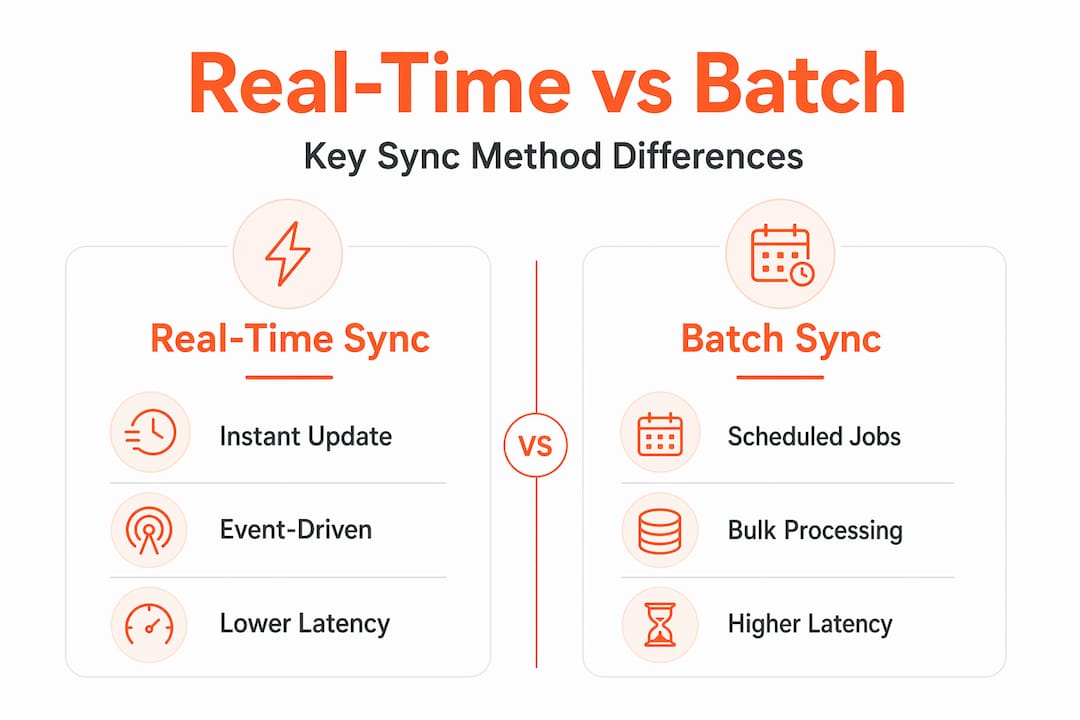
Real-time data synchronization is the continuous, near-instantaneous movement of data changes from a source system to one or more destination systems. As soon as a record is created, updated, or deleted in the source, that change travels downstream without waiting for a scheduled job. Real-time updates propagate changes as soon as they happen, while batch sync runs at scheduled intervals and creates windows where systems fall out of alignment.
The distinction matters more than it sounds. A sales rep updating a deal in your CRM while the billing system still shows the old contract value is not a minor inconvenience. It's a data blackout that can trigger wrong invoices, missed alerts, and flawed forecasts.
Event-driven architecture
The most direct approach to real-time data synchronization is event-driven architecture. When data changes in the source system, that system emits an event, typically via a webhook or a message broker. Source systems emit events when data changes and integration platforms process those updates immediately, with no waiting and no polling.
Think of it like a smoke detector. You don't check the room for smoke every 30 minutes. The detector fires the moment conditions change. Event-driven sync works the same way.
Polling-based sync
Polling is the older, simpler alternative. Your integration layer asks the source system, "Has anything changed since I last checked?" on a fixed schedule. Polling intervals can range from 30 seconds to several minutes, which means you always carry at least that much latency. It's easier to implement, but it's not truly real-time. For many internal workflows, that gap is acceptable. For anything customer-facing or time-sensitive, it usually isn't.
Change data capture (CDC)
CDC operates at the database layer rather than the application layer. Instead of watching for API events or polling tables, it reads the database's transaction log. CDC uses write-ahead logging to capture inserts, updates, and deletes in real time without expensive table scans. PostgreSQL's WAL is a common example. Every committed transaction gets recorded there first, and CDC tools stream those log entries to downstream systems with near-zero latency and minimal load on the source database.

Field-level change tracking
Regardless of which method you use, granularity matters. Sync engines that track which fields changed update only those values rather than overwriting entire records. This is especially critical when two systems can write to the same record. Without field-level tracking, a sync from System A could silently erase a concurrent update made in System B.
Pro Tip: When designing a bi-directional sync, map out every field that both systems can write to before you build anything. Those fields need explicit conflict resolution rules, not just last-write-wins logic.
Comparing the main sync methods
Choosing the right data synchronization method comes down to three factors: how much latency you can tolerate, how complex your infrastructure can be, and how critical reliability is when things go wrong.
| Method | Typical latency | Complexity | Best suited for |
|---|---|---|---|
| Event-driven (webhooks) | Milliseconds to seconds | Medium to high | SaaS integrations, CRM sync, real-time notifications |
| Polling-based | Seconds to minutes | Low | Internal tools, low-frequency updates, simple pipelines |
| Change data capture (CDC) | Near-zero (sub-second) | High | Database replication, analytics pipelines, IoT data |
Event-driven syncing with webhooks is the most efficient approach, but it requires robust error handling because dropped events can cause silent data loss. CDC using WAL logs captures every database transaction with minimal performance impact compared to polling entire tables, making it the preferred choice for high-volume database workloads.
Latency is only part of the picture. Event-driven architectures include built-in retry and conflict management for reliable syncing, but those features require deliberate design. A webhook that fires once and never retries on failure is not a production-ready sync system.
It's also worth acknowledging that "real-time" covers a spectrum. Near real-time sync involves minimal delay, typically seconds to a few minutes, which is sufficient for most enterprise workflows outside of ultra-low-latency scenarios like high-frequency trading. Knowing where your use case sits on that spectrum helps you choose the right method without over-engineering.
Pro Tip: Real-world implementations often combine event-driven triggers with a polling fallback. If a webhook fails silently, the polling layer catches the missed change on its next cycle. This hybrid approach adds reliability without sacrificing much latency.
Implementation patterns that actually hold up
Getting real-time data processing right in production means thinking beyond the happy path. Here's how most solid implementations are structured:
-
Choose your trigger mechanism. Webhooks work well for SaaS-to-SaaS integrations. Message queues like Kafka or RabbitMQ are better when you need guaranteed delivery, fan-out to multiple consumers, or the ability to replay events. CDC is the right call when you need database-level fidelity.
-
Build your integration layer. API connectivity, field mapping, and secure data pipelines are the three pillars of a working integration layer. Authentication to both source and destination systems must be handled before a single byte of data moves. OAuth tokens, API keys, and service accounts all need rotation policies.
-
Define your data mapping. Source and destination schemas rarely match perfectly. Your integration layer needs explicit rules for transforming field names, data types, and value formats. A phone number stored as a string in one system and as an integer in another will break silently if you don't account for it.
-
Implement incremental sync logic. Full-table syncs are expensive and slow. Use timestamps, sequence numbers, or CDC log positions to sync only what changed since the last successful run.
-
Add retry logic and dead-letter queues. Network failures happen. A robust sync system retries failed events with exponential backoff and routes persistently failing messages to a dead-letter queue for inspection rather than silently dropping them.
-
Monitor end-to-end latency, not just trigger latency. End-to-end latency should be measured holistically, not just at the trigger point. Buffering, queuing, and transformation steps all add time. Track the full journey from source change to destination write.
-
Plan for conflict resolution. Decide upfront how you handle concurrent writes. Options include last-write-wins, source-of-truth priority, field-level merging, and manual review queues. There is no universally correct answer, only the one that fits your data model.
Benefits and use cases worth knowing
The benefits of real-time syncing go beyond speed. When your systems share a consistent view of the truth, everything downstream gets more reliable.
Here's where real-time data synchronization delivers the most tangible value:
- Faster decisions. Sales teams see pipeline updates the moment a rep closes a deal. Finance sees the same number without waiting for an overnight batch job.
- Reduced operational errors. When inventory, order management, and fulfillment systems stay in sync, you stop shipping products you don't have.
- Responsive analytics. Real-time data processing feeds live dashboards that reflect current conditions, not conditions from three hours ago.
- Automation that actually fires on time. Workflow triggers based on stale data produce delayed or incorrect actions. Real-time sync keeps automation grounded in what's actually happening.
Applications requiring immediate data freshness include stock trading platforms, emergency response systems, and CRM pipelines where a delayed update can mean a missed opportunity or a critical failure. These aren't edge cases. They're the norm for any team operating at scale.
Batch sync still has a role. For data warehousing, historical reporting, and large-scale ETL jobs where latency is acceptable, scheduled batch processes are often more cost-effective. The importance of real-time data is not that it replaces batch everywhere. It's that you use each approach where it actually fits.
My honest take on real-time sync
I've seen a lot of teams get burned by the gap between what a vendor calls "real-time" and what actually happens in production. The label gets applied to anything from true sub-second sync to a polling job that runs every five minutes. That ambiguity is not just a marketing problem. It shapes architectural decisions that are expensive to undo.
What I've learned from working with sync systems across different scales is that the trigger mechanism is rarely where things break. It's the middle layer: the retry logic, the conflict resolution, the monitoring. Teams spend weeks perfecting the event emission and then ship with no dead-letter queue and no alerting on sync lag. That's where data loss quietly accumulates.
My other observation is that most teams reach for real-time sync when near-real-time would serve them just as well and be significantly easier to operate. If your use case tolerates a 30-second delay, a well-built polling approach with proper error handling will outperform a fragile webhook setup in reliability. Speed is only one dimension of sync quality.
The most durable systems I've seen combine methods deliberately. Event-driven for the primary path, polling as a safety net, and CDC where database fidelity is non-negotiable. That combination is more work upfront, but it's the architecture that holds up when traffic spikes, networks hiccup, and source systems behave unexpectedly.
— Rickard
How Gainable keeps your data current without the complexity
Real-time data synchronization is powerful, but building and maintaining the infrastructure for it is a significant investment. That's where Gainable changes the equation for modern teams.
Gainable connects directly to your existing data sources, including HubSpot, Stripe, and spreadsheets, and auto-generates apps that reflect your actual workflows. No custom pipelines to build. No integration layer to maintain from scratch. When your source data changes, your Gainable app reflects it. Teams get the benefits of real-time data updates without becoming experts in CDC or webhook infrastructure. If you're ready to stop managing data manually and start working with it in real time, explore Gainable and see how fast you can go from data source to working app.
FAQ
What is real-time data sync in simple terms?
Real-time data sync is the process of moving data changes from one system to another the moment they occur, rather than waiting for a scheduled batch job. The goal is to keep all connected systems reflecting the same current state.
How does data sync work at the technical level?
Data sync works by detecting changes in a source system through events, polling, or transaction log reading, then transmitting those changes to destination systems through APIs, message queues, or direct database connections.
What is the difference between data sync vs batch sync?
Real-time sync propagates changes immediately upon detection, while batch sync collects changes over a period and processes them all at once on a schedule. Batch sync introduces latency equal to the interval between runs.
When should you use CDC over event-driven sync?
CDC is the better choice when you need database-level fidelity, high-volume transaction capture, or when the source system does not expose a reliable event or webhook API. It reads directly from the transaction log with minimal impact on the source database.
How do you handle conflicts in real-time data synchronization?
Conflict resolution strategies include last-write-wins, designating one system as the authoritative source for specific fields, field-level merging, and routing conflicts to a manual review queue. The right strategy depends on your data model and how many systems can write to the same records.