

Existing datasets are the critical foundation that powers app functionality, accelerates development cycles, and drives data-driven decisions across every product team. The role of existing datasets in apps goes far beyond storage. Datasets define what your app can do, how fast you can build it, and how defensible your product becomes over time. Industry research shows that 30% of GenAI projects fail after proof-of-concept, most often because teams skip structured data integration. Data governance frameworks like DAMA-DMBOK recognize data as a first-class organizational asset, not a byproduct of software. If you are a developer, data analyst, or product manager, understanding how datasets shape your app is the most practical competitive edge you have right now.
How do existing datasets accelerate app development and improve functionality?
Reusing existing data cuts the most expensive part of any project: raw data collection. When your team starts with a curated dataset, you skip weeks or months of gathering, labeling, and cleaning. That time goes directly into building features that users actually need.
Public datasets make this even faster for early-stage projects. Platforms like Kaggle give developers immediate access to structured data for recommendation engines, classification models, and user behavior analysis. What used to take months of collection now takes an afternoon of setup. That speed matters most during the MVP phase, when validating assumptions quickly determines whether a product survives.

Using datasets for app development also improves model training quality. A curated dataset with clear labels and consistent formatting produces more reliable outputs than raw, unprocessed data. Teams that start with well-structured existing data sources in mobile apps report fewer edge-case failures during testing and faster iteration cycles after launch.
The benefits of datasets in software extend to prototyping as well. When your data already exists, you can wire up a working prototype in days rather than weeks. Product managers can show stakeholders a real, functioning demo instead of a slide deck. That shortens feedback loops and reduces the risk of building the wrong thing.
- Faster MVPs: Existing datasets remove the cold-start problem. You have real data to populate your app from day one.
- Better model training: Curated datasets reduce noise and improve the accuracy of AI-powered features.
- Shorter feedback cycles: Working prototypes built on real data generate more useful stakeholder input.
- Lower error rates: Structured data reduces the number of edge cases that surface during QA.
Pro Tip: Use Retrieval-Augmented Generation (RAG) to connect your enterprise data to AI features without retraining models. RAG lets your app query live data at inference time, which keeps responses accurate and current without expensive model updates.
Why is dataset quality and integration critical for reliable app performance?
Dataset quality is the single biggest predictor of whether an app delivers on its promise. A well-designed feature built on stale or poorly joined data will fail in production, even if the code is perfect. This is not a theoretical risk. Failure caused by retrieving incorrect or stale data without proper validation, metadata, and access controls accounts for a significant share of AI project failures.
Four specific gaps cause most dataset-related app failures:
- Missing join-aware context. When your app queries data across multiple tables or sources, it needs to understand relationships between records. Without join-aware structure, queries return incomplete or misleading results.
- Stale data without effective dates. Data that lacks timestamps or effective date metadata causes apps to serve outdated information as if it were current. This is especially damaging in financial and CRM applications.
- No retrieval-grade metadata. Ownership fields, sensitivity classifications, and data lineage records are not optional extras. They are what make a dataset reusable across multiple app features without creating security or compliance risks.
- Absent role-based access control. Without access controls baked into the dataset layer, apps either over-expose sensitive records or require complex workarounds that slow development.
Treating metadata as a first-class citizen of your dataset design is what separates a reusable data product from a one-time data dump. Ownership, effective dates, sensitivity labels, and lineage records turn raw tables into assets that multiple app features can safely share.
Proper integration also creates reusable data products. When your dataset is versioned, validated, and governed, any team in your organization can build on it without starting from scratch. That reusability compounds over time. Each new app feature that draws from a shared, well-governed dataset adds value without adding data debt. Data reliability is the foundation that makes every data-driven feature trustworthy, and trustworthy features are the ones users actually rely on.
How do existing datasets create long-term competitive advantages for apps?
The most defensible competitive advantage in software is not your code. It is your data. The enriched dataset created via app usage feedback loops is the true asset driving future improvements, independent of the app's distribution channel. Software can be copied. A proprietary dataset built from years of real user interactions cannot.
This is the flywheel effect in practice. Your app generates data. That data trains better models and surfaces better insights. Better insights improve the app. A better app attracts more users. More users generate more data. Each cycle makes your dataset more valuable and your app harder to replicate.
- Data compounds in value. Unlike software features, which depreciate as competitors copy them, datasets grow more valuable with every user interaction and enrichment cycle.
- Golden datasets define quality. Starting with 8–20 curated scenarios that represent ideal app behavior gives your team a quantitative benchmark for measuring improvement over time.
- Feedback loops create proprietary assets. User behavior data collected through your app becomes a dataset no competitor can purchase or replicate.
- Data-first development shifts priorities. Teams that treat datasets as primary products allocate more resources to data quality and governance, which pays off in app reliability and longevity.
The organizational challenge is real. Shifting from an app-centric to a data-centric mindset requires product managers to think about data collection as a feature, not a side effect. It requires developers to design event tracking intentionally from the start. And it requires data analysts to be involved in product decisions, not just reporting.
Pro Tip: Build your CRM data enrichment strategy before you finalize your app's data model. Enriched CRM records become the foundation for personalization, segmentation, and predictive features that set your app apart.
What are best practices for leveraging existing datasets effectively in app projects?
The gap between teams that succeed with data and teams that struggle usually comes down to when data thinking enters the product process. Embedding data science into product design from day one transforms apps from reactive analytics tools into proactive systems guided by user behavior and predictive models. That shift does not happen by accident.
The table below compares two approaches to dataset integration in app projects.
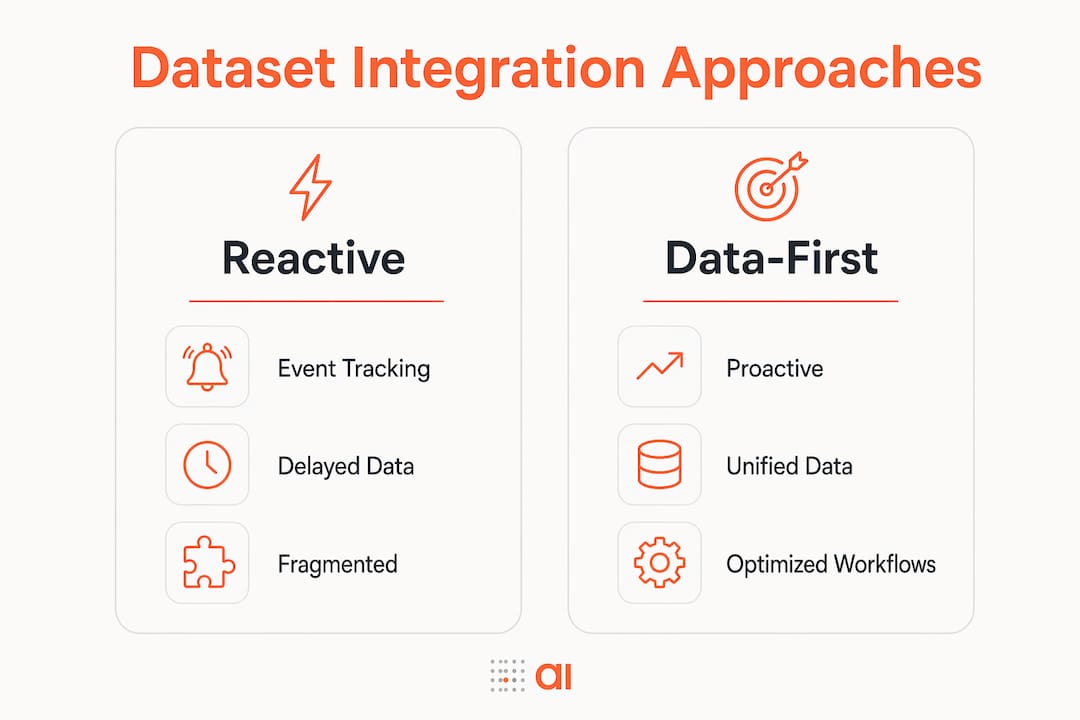
| Practice area | Reactive approach | Data-first approach |
|---|---|---|
| Event tracking | Added after launch as an afterthought | Designed intentionally before the first sprint |
| Dataset governance | Managed by a separate data team post-launch | Embedded in product specs from day one |
| Evaluation criteria | Subjective user feedback and gut feel | Golden datasets with quantitative success metrics |
| Failure response | Debug code first, check data second | Dataset patching as the primary improvement mechanism |
| Data reuse | Each feature builds its own data pipeline | Shared, versioned data products used across features |
Well-run products have no unused data. Every event your app fires, every record it creates, and every interaction it logs should feed back into a pipeline that improves the next version. "Dark data," which is data collected but never used, is a symptom of misaligned product and data teams. Fixing that alignment is the highest-leverage change most product organizations can make.
Creating a golden dataset early is the most underused practice in AI-powered app development. A golden dataset of 8–20 representative scenarios with clear expected outputs gives your team an objective way to measure whether a model change or dataset patch actually improved performance. Without it, you are guessing. With it, you are measuring. That difference determines whether your app gets better systematically or just occasionally.
Connecting your Stripe data to a custom app is a practical example of this principle. When payment data flows directly into your app's dataset layer, you can build features like churn prediction, revenue forecasting, and customer segmentation without building a separate data pipeline for each one.
Key Takeaways
Existing datasets are the primary driver of app quality, development speed, and long-term competitive advantage. Teams that treat data as a product, not a byproduct, build better apps faster and defend them more effectively.
| Point | Details |
|---|---|
| Datasets accelerate development | Reusing existing data cuts collection time and enables working MVPs in days, not months. |
| Quality and governance prevent failure | Missing metadata, stale records, and absent access controls cause 30% of AI project failures. |
| Data compounds as a competitive asset | Enriched datasets grow in value through user feedback loops, creating advantages software alone cannot replicate. |
| Golden datasets enable objective evaluation | Starting with 8–20 curated scenarios gives teams a quantitative benchmark for measuring app improvement. |
| Data-first design eliminates dark data | Intentional event tracking and shared data pipelines from day one prevent wasted data and misaligned teams. |
Why I think most teams are still treating data as an afterthought
After years of watching product teams build apps, the pattern I see most often is this: data is something you think about after the app is already built. The product manager defines features. The developer ships code. Then, six months later, someone asks why the AI feature is not performing well. The answer is almost always the dataset.
The teams that get this right do something counterintuitive. They spend more time on data design before writing a single line of application code. They map out what data they already have, what gaps exist, and how they will collect new signals through the app itself. That upfront investment looks slow. It is actually the fastest path to a reliable, defensible product.
The shift from app-centric to data-centric thinking is uncomfortable at first. Product managers feel like they are doing data engineering work. Developers feel like they are being asked to slow down. But the teams I have seen make this shift consistently ship features that work better on day one and improve faster over time. The data does the heavy lifting that code alone cannot do.
My advice: treat your dataset as the first deliverable of any new app project. Define your golden dataset before you write your first user story. You will ship a better product, and you will know exactly why it is better.
— Rickard
How Gainable turns your existing data into working apps
Building apps around your existing datasets does not have to mean months of engineering work. Gainable connects directly to your live data sources, including HubSpot, Stripe, and Google Sheets, and auto-generates apps that reflect your actual workflows. No coding required.
Gainable's data connectors pull from multiple sources simultaneously, so your app always reflects current data without manual syncing. The app builder lets you create and refine features using plain language queries, which means your product and data teams can iterate together without waiting on engineering sprints. Embedded AI copilots draw on your existing datasets to surface insights and draft actions directly inside the app. If you want to see how your data can power a working app today, Gainable is built exactly for that.
FAQ
What is the role of existing datasets in apps?
Existing datasets power app features, train AI models, and enable data-driven decisions without requiring teams to collect raw data from scratch. They are the foundation that determines what an app can do and how reliably it performs.
Why do so many AI app projects fail after the proof-of-concept stage?
30% of GenAI projects fail after proof-of-concept because they lack join-aware database context, proper metadata, and data governance. Without these, apps retrieve incorrect or stale data in production.
What is a golden dataset and why does it matter?
A golden dataset is a curated collection of representative scenarios with defined expected outputs, typically 8–20 examples, used to measure app performance objectively. It replaces subjective evaluation with quantitative tracking of improvement over time.
How do datasets create a competitive moat for apps?
Apps generate proprietary data through user interactions, and that data compounds in value over time through enrichment and feedback loops. The resulting dataset is harder for competitors to replicate than any software feature.
How can product teams avoid dark data in their apps?
Intentional event tracking design and shared data pipelines built into the product from day one prevent dark data. Every data point your app collects should feed a pipeline that improves the next version of the product.