

Most sales teams aren't failing at communication. They're failing at integration. I've watched five-person sales teams run three chat apps, two spreadsheets, and a CRM that nobody updates, then call it "staying flexible." It isn't flexibility. It's a slow productivity leak that compounds every week.
This is a guide to the tools sales teams use in 2026, what each one does well, and where the productivity gains live. I'll cover the leading platforms, then explain why most teams overestimate tool selection and underestimate the connections between tools.
The platforms worth knowing
The market splits into four buckets in 2026: communication, task management, CRM with workflow built in, and the newer AI coordination layer that automates the cognitive overhead of running a sales org.
Slack
Slack passed 38 million daily active users this year and remains the default for sales teams under 500 people. Real-time messaging, file sharing, audio huddles, and video calls all live in one window. Reps run dedicated channels per account, region, and product line. The AI notification layer surfaces what matters, though it's not magic. What makes Slack work for sales is the integration depth: Asana, Pipedrive, HubSpot, Salesforce, and most CRMs ship first-class workflows that fire alerts when deals move stages.
Where I'd push back on the hype: Slack is excellent at conversation and bad at memory. Anything important you discuss in a channel needs a home somewhere else, or you'll be searching for it again in a week.
Asana
If you've outgrown chat threads as your task system, Asana is the next stop. Visual project management, task assignment, deadlines, and goals tied to revenue targets. The 2026 release added AI triage that reads Slack questions, attempts to resolve them, and creates a tracked task with a named owner when it can't. Resolution time drops from days to minutes for the categories of work where that pattern fits.
Honest take: Asana shines for teams of 15 to 100 reps. Below that it's overhead. Above that you're probably already on something heavier.
Pipedrive
Pipedrive is a CRM built around the way salespeople work. A deal moves a stage, a Slack message fires, a follow-up task is assigned, and the activity is logged, all automatically. For SMBs and growing sales teams it's the cleanest way to remove the manual coordination that slows pipelines down. Starts around $14 per user per month.
Microsoft Teams
If your company runs Microsoft 365, Teams is the dominant choice and probably non-negotiable. Persistent chat, video conferencing, file collaboration through SharePoint, and deep integration with Dynamics 365. The strength is governance, compliance, and central IT management. The cost is that it can feel heavier than Slack for reps who just want to message a colleague.
Trello
Trello uses Kanban boards. It's lightweight, fast to set up, and requires almost no training. Smaller sales teams use it to track outreach sequences, onboarding tasks, or proposal workflows. The ceiling is low, which is part of the appeal. You don't grow into Trello, you graduate from it.
Google Workspace
Docs, Sheets, Slides, Drive, and Meet are the document backbone for most SMB and mid-market sales teams. Shared pitch decks, proposal templates, and territory planning spreadsheets all co-edit in real time. Meet handles video. Gmail keeps it stitched together.
Anthropic's Claude Cowork
Claude Cowork is the AI coordination layer that started showing up in sales orgs over the last year. It automates meeting briefs, weekly forecasts, and account scoring. Early adopters report saving sales leaders up to 90 minutes daily on meeting preparation and around 3 hours weekly on reporting. One published case scored 4,000 accounts to prioritize outreach. It's a runtime that handles the work nobody wants to do on Sunday night, not a chat assistant you ask one-off questions.
Where the productivity gain lives
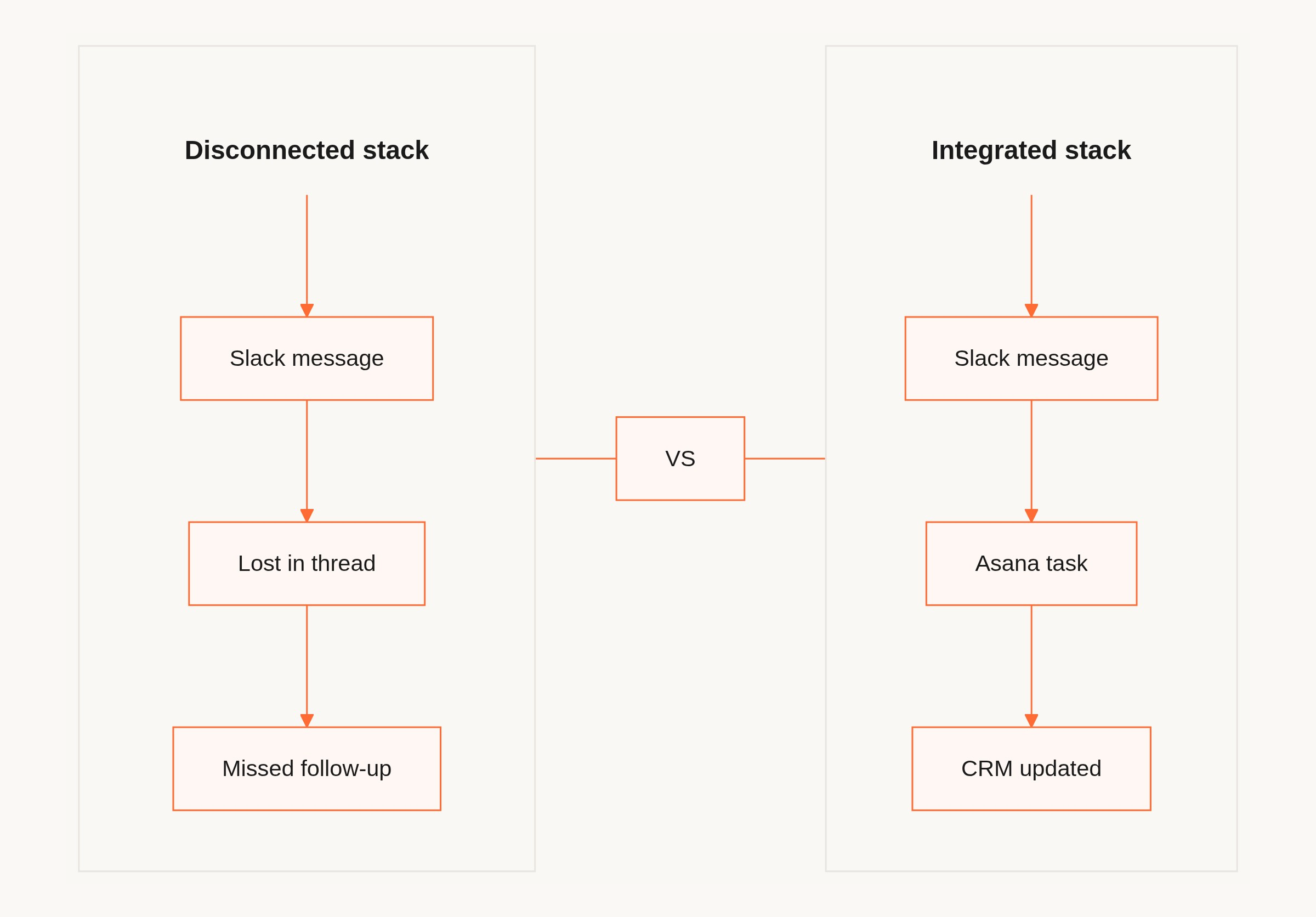
Here's the thing that took me years of watching customers to internalize: the tool matters less than the integration. Slack on its own is fine. Slack connected to Asana, which is connected to your CRM, is a different category of product.
The Slack and Asana integration is the clearest example. A rep posts a question in a channel. The AI triage reads it, tries to resolve it, and if it can't, it spawns a tracked task with a named owner and a visible deadline. Accountability becomes part of the workflow instead of something enforced through follow-up emails.
Claude Cowork pushes the same idea further by automating the artifacts around meetings: briefs, summaries, and action items. Sales leaders who used to spend Sunday evenings preparing Monday forecasts now open a drafted report. That time goes back to coaching reps and closing deals, which is the work that pays.
If your collaboration setup feels broken, ask whether the tools are integrated before you buy another one. Nine times out of ten the API connection exists and nobody has set it up yet.
A comparison at a glance
| Tool | Primary function | AI features | Key integrations | Best for |
|---|---|---|---|---|
| Slack | Team communication | AI notifications, workflow automation | Asana, Pipedrive, Google Workspace, Zoom | All team sizes |
| Asana | Task and project management | AI triage, goal tracking | Slack, Zoom, Notion, Google Workspace | Mid to large teams |
| Pipedrive | CRM with workflow automation | Deal scoring, activity automation | Slack, Google Workspace, Zoom | Sales-focused SMBs |
| Microsoft Teams | Enterprise messaging and video | Copilot AI assistant | Dynamics 365, SharePoint, Office 365 | Enterprise teams |
| Trello | Kanban task management | Basic automation (Butler) | Slack, Google Drive, Jira | Small teams, simple workflows |
| Google Workspace | Document and video collaboration | Gemini AI in Docs and Sheets | Slack, Asana, Zoom | All team sizes |
| Claude Cowork | AI sales automation | Forecasting, scoring, meeting briefs | CRM data sources | Sales leaders and ops |
Pricing varies. Slack, Trello, and Google Workspace have free tiers with meaningful functionality. Asana's free plan covers basic task management. Microsoft Teams comes with Microsoft 365. Pipedrive starts at $14 per user per month. Claude Cowork pricing is enterprise-negotiated. For most growing sales teams, Slack plus Asana plus a CRM covers the majority of coordination needs without heavy investment.
What to pick for your team
Choosing the right setup depends on size, sales complexity, and how your team works day to day.
Small sales teams and startups, 1 to 15 reps: Trello or ClickUp for lightweight task tracking, Slack for communication on the free or Pro tier, Pipedrive as a CRM that integrates with both without needing a dedicated ops person, and Google Workspace for proposals and shared docs.
Mid-size sales teams, 15 to 100 reps: Slack plus Asana as the backbone, Pipedrive or a similar CRM with Slack integration for deal updates, and Zoom for client and team calls. AI call coaching can help rep performance at scale if you have the budget for it.
Enterprise sales organizations, 100+ reps: Microsoft Teams as the central hub, Salesforce or Dynamics 365 as the CRM, Asana or a similar platform for cross-functional project coordination, and Claude Cowork or a similar AI layer for forecasting and account prioritization.
Remote and hybrid sales teams: Slack for asynchronous communication, Zoom for synchronous client and team calls, Miro for visual collaboration on territory planning or strategy sessions, and Asana to maintain task visibility when the team isn't in the same room.
When AI coordination earns its place: If your sales leaders spend more than two hours a week on reporting, forecasting, or meeting prep, AI tools like Claude Cowork pay back fast. The 90-minute daily saving on meeting briefs alone justifies the investment for high-volume pipelines. Start with AI triage in Asana or Slack before committing to a full AI platform, so you can measure the impact on your specific workflow.
What I've learned from watching sales teams adopt collaboration tools
A few patterns hold up across every team I've worked with over the last 25 years.
Teams that get the most out of collaboration tools treat the toolset as a system. Communication, task tracking, and CRM data have to connect. When a Slack message about a stalled deal automatically creates an Asana task with a deadline and an owner, that's the difference between a deal that closes and one that quietly dies in a thread nobody checks.
I'd push back on the instinct to add more tools when collaboration breaks down. More often the problem is that the existing tools aren't integrated. Ask whether your current tools have an API connection you haven't set up yet before you buy a new platform.
The AI piece is delivering value, but it's easy to overhype. Start small. Measure whether resolution times improve. Then decide if a full AI coordination layer like Claude Cowork makes sense at your scale. Adoption matters more than feature lists. A tool your team uses every day beats a sophisticated platform that sits untouched.
How Gainable fits in
If you're building out your sales collaboration stack, the missing piece is usually a live view of your pipeline data inside the tools your team already uses.
Gainable is what I built for that gap. Upload your CRM export, your HubSpot extract, or a sales spreadsheet, and Gainable infers the structure, the relationships, and the context, then builds the full app. Zero prompts to start. Pipeline board, dashboards, forecasting view, the lot. Built-in chat, comments, and file sharing live next to the data, so conversations stay attached to the deals they belong to instead of scattered across threads. Gaia Copilot reads your live data and answers questions like "which deals are at risk this quarter" without anyone writing a query. Gaia Autopilot drafts work into your inbox before you ask for it.
It's not a replacement for Slack or Asana. It's the layer that makes the rest of your stack smarter by giving your team an app built around your data, with collaboration tied to the deals themselves. If you want to see what it looks like on your data, start a workspace and upload a sales spreadsheet.