
Real-time app updates deliver data changes to users the moment they happen, no refresh required. The mechanism behind this is a persistent connection between client and server, where the server pushes new data rather than waiting for the client to ask. That shift from pull to push is the core of how real-time updates function, and it changes everything about how you architect an app.
Three transport mechanisms power most real-time systems today:
- WebSocket: A full-duplex protocol over a single TCP connection, letting both sides send messages independently at any time. Best for chat, collaborative editing, and multiplayer games.
- Server-Sent Events (SSE): A simpler, unidirectional stream from server to client. No two-way messaging, but easier to implement and sufficient for dashboards, stock tickers, and notifications.
- Long polling: The client sends a request, the server holds it open until data is ready, then responds. The client immediately fires another request. It works, but it generates more HTTP overhead than either of the above.
Traditional HTTP polling asks “anything new?” on a timer. Real-time push says “I’ll tell you when something changes.” The difference in latency and server load is significant, especially under concurrent users.
How real-time app updates work under the hood
The transport layer is only part of the picture. What actually triggers an update starts deeper, at the database.

Database change detection
Backends like Supabase listen to Postgres Write-Ahead Logs to detect mutations the moment they are committed. The WAL is a sequential record of every insert, update, and delete, and tapping it means no polling the database itself. Firebase takes a similar approach: the SDK listens to an internal changelog that fans out updates to every registered snapshot listener, with a reverse query matcher checking which listeners care about the changed document.
Event propagation flow
Once a change is detected, the backend broadcasts it to subscribed clients. A simplified flow looks like this:
- A write commits to the database.
- The WAL or changelog captures the mutation.
- The backend appends subscriber IDs to the change record.
- The event routes to the correct WebSocket connections.
- The client receives a delta frame and updates the UI.
Pro Tip: For ephemeral, high-frequency events like typing indicators or cursor positions, skip database persistence entirely. Broadcast channels route messages directly between clients over the cluster, cutting latency and infrastructure load.
Connection management and delta sync
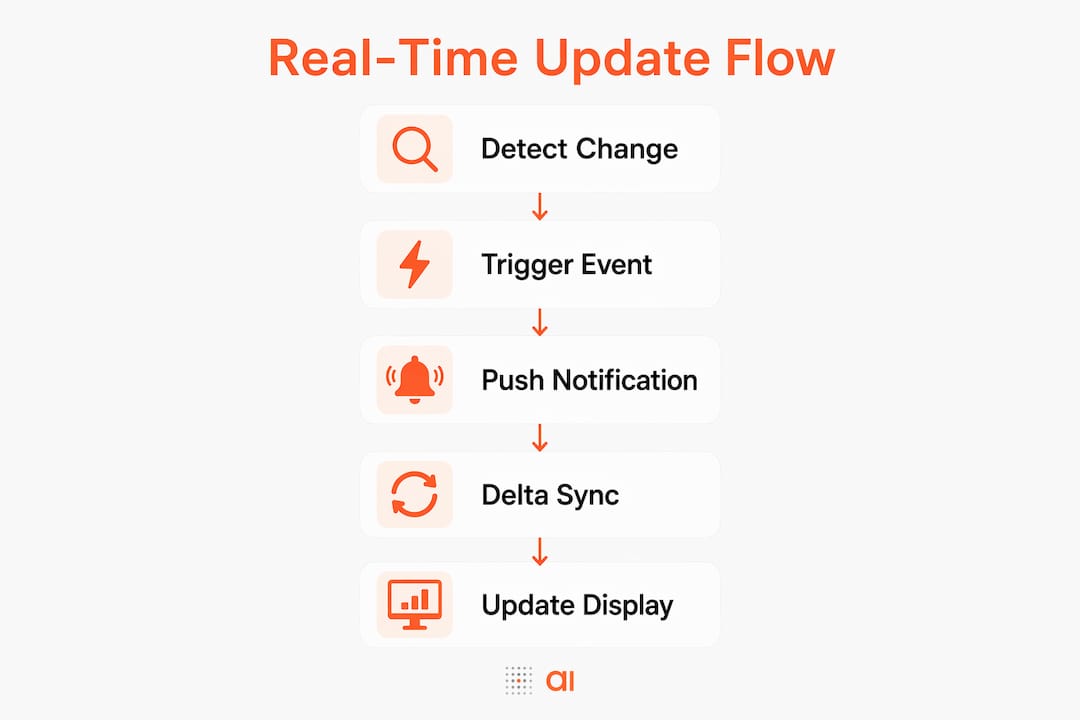
Networks drop. Laptops close. A production-ready real-time system handles this without losing data. Reliable apps pair WebSocket push with delta sync on reconnect: when the socket comes back up, the client requests all frames it missed since its last known sync ID, then resumes live updates. No silent gaps, no stale state.

| Mechanism | Direction | Latency | Best for |
|---|---|---|---|
| WebSocket | Bidirectional | Very low | Chat, gaming, collaboration |
| Server-Sent Events | Server to client | Low | Dashboards, feeds, notifications |
| Long polling | Server to client | Medium | Fallback when WebSockets unavailable |
| Broadcast channel | Client to clients | Very low | Typing indicators, presence, game state |
Why real-time updates matter and where you see them
The user experience argument is straightforward: nobody wants to hit refresh to see if a teammate moved a task. But the developer productivity argument is just as strong. Platforms like Firebase and Supabase handle the WebSocket infrastructure, WAL integration, and fan-out logic for you, so you write a subscription and get live data without managing a socket server.
Real-world scenarios where live data updates change the product:
- Collaborative document editing: Every keystroke from one user appears on another’s screen within milliseconds. Google Docs-style presence requires both data sync and user state tracking.
- Live chat: Each message is a new database row. Clients subscribe to the table and receive inserts as they happen, with real-time data transmission replacing any polling loop.
- Multiplayer game state: Player positions, scores, and turn changes sync via broadcast channels. The latency tolerance here is tight, often under 100ms.
- Operations dashboards: Order counts, active sessions, and pipeline totals update as the underlying rows change. Teams stop asking “is this current?” and start acting on what they see.
- Notifications: Instead of a client polling a notifications table every 30 seconds, a subscription fires the moment a new row is inserted.
Firebase’s latency compensation is worth calling out specifically. When you write locally, the SDK applies the change to the UI immediately and marks it as pending, then reconciles once the server confirms. The user sees an instant response even before the round trip completes. That pattern, optimistic UI with server reconciliation, is now a standard practice in real-time app development.
For teams building apps on top of live data, Gainable’s app builder platform ships with live updates built in, so you get this behavior without wiring it yourself.
Challenges developers run into with real-time systems
Real-time is not free complexity. Treating it as a feature to bolt on rather than an architectural foundation is the most common mistake, and it tends to surface at the worst time: under load, after launch.
Here are the challenges you will actually face:
- Connection state management: Each WebSocket connection is stateful. Tracking which clients are subscribed to which channels, and cleaning up when they disconnect, requires careful design. Naive database flags break under high concurrency. Presence systems need in-memory, CRDT-backed stores to stay consistent across nodes.
- Scalability under load: A single server can only hold so many open connections. Horizontal scaling requires a message broker (Redis Pub/Sub, for example) so any server instance can publish to any connected client. Without this, you get split-brain: clients on different nodes miss each other’s events.
- Security: WebSocket connections authenticate at handshake time, typically via a token in the query parameter. If that token expires or the user logs out, the connection must close and reopen with fresh credentials. Row-level security policies, like those Supabase applies to database change subscriptions, prevent clients from receiving data they are not authorized to see.
- Consistency trade-offs: Achieving perfect consistency across thousands of concurrent connections is extremely hard. Most production systems embrace eventual consistency and optimistic UI updates, accepting that two clients might briefly see different states. The key is designing conflict resolution upfront, not discovering you need it after users report data loss.
- Offline and reconnect scenarios: What happens when a user goes offline for an hour, edits five records locally, then reconnects? You need a transaction queue, a delta sync on reconnect, and a conflict resolution strategy. Last-write-wins is simple but can silently overwrite work. Notifying the user of conflicts is better UX.
- Mobile resource usage: Keeping a WebSocket open in the background drains battery and consumes data. Always call
unsubscribe()when a component unmounts, and consider whether background subscriptions are worth the cost for your use case. For automatic update strategies on mobile, the right answer is often a push notification that triggers a fetch, not a persistent socket.
Key Takeaways
Real-time app updates require persistent WebSocket connections, database change detection via WAL or changelogs, and deliberate conflict resolution to deliver consistent live data at scale.
| Point | Details |
|---|---|
| WebSocket is the foundation | Full-duplex TCP connections let server and client exchange messages independently with very low latency. |
| WAL and changelogs drive updates | Backends like Supabase and Firebase tap database logs to detect changes and broadcast them instantly to subscribers. |
| Delta sync prevents data gaps | Pairing WebSocket push with delta sync on reconnect eliminates silent data loss from dropped connections. |
| Eventual consistency is the norm | Most real-time systems use optimistic UI updates and accept brief inconsistency to keep the experience fluid. |
| Architecture decisions are permanent | Building real-time in from the start avoids expensive retrofits; bolting it on later compounds every other challenge. |